In the world of sous vide cooking, precision is not just a preference—it's the very foundation of the technique. While many home cooks might view temperature settings as flexible guidelines, professional chefs and food scientists understand that a difference of even half a degree Celsius can dramatically alter the final product. This brings us to a question that often puzzles enthusiasts: why would a recipe specify 63.5°C instead of a round number like 63°C? The answer lies at the fascinating intersection of food science, protein chemistry, and culinary artistry.
To understand the significance of 63.5°C, we must first appreciate what happens to food at the molecular level when heat is applied. Proteins, the building blocks of meat, fish, and eggs, undergo a process called denaturation when heated. This involves the unraveling of protein structures and their subsequent reformation into new configurations. The temperature at which this occurs is not a single point but rather a range, and different proteins denature at different temperatures. For instance, the protein myosin in meat begins to denature around 40°C, while actin requires higher temperatures, starting around 66°C. The magic of sous vide is maintaining food at a precise temperature within these ranges to achieve specific textural outcomes.
The number 63.5°C is particularly significant for cooking eggs and certain cuts of meat. Let’s consider eggs first. Egg yolks and egg whites contain different proteins that coagulate at different temperatures. The protein in egg whites begins to thicken around 61°C and becomes fully set around 65°C. Egg yolk proteins start to thicken around 65°C and become fully set near 70°C. At 63.5°C, you hit a sweet spot where the white is set to a custard-like consistency while the yolk remains beautifully thick, creamy, and liquid—a texture highly prized for dishes like poached eggs or eggs Benedict. At 63°C, the white might be slightly too runny for some applications, while at 64°C, the yolk might begin to firm up too much. That half-degree is the difference between good and perfect.
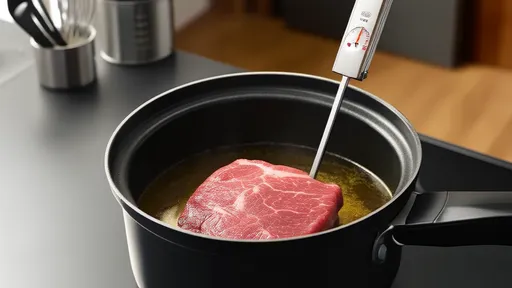
When it comes to meat, particularly beef, the precision of 63.5°C is often associated with achieving a perfect medium-rare doneness. However, doneness is not just about temperature; it's also about time. The concept of pasteurization plays a crucial role here. To eliminate potential pathogens like Salmonella and E. coli, food needs to be held at a specific temperature for a specific duration. For example, at 63.5°C, it takes approximately 13 minutes to pasteurize a piece of beef that is 25mm thick. If the temperature were dropped to 63°C, the required time would increase significantly to nearly 30 minutes for the same level of safety. This extended time can begin to affect texture, potentially making the meat softer than desired as connective tissues break down more than intended. Therefore, 63.5°C offers an optimal balance of safety and texture, ensuring the meat is both safe to eat and perfectly tender.
Another layer to this precision is the phenomenon of carryover cooking. In traditional methods like grilling or roasting, food continues to cook after being removed from the heat source due to residual internal heat. This makes hitting an exact final internal temperature challenging. Sous vide eliminates this variable. Because the entire item is brought to and held at the exact target temperature, there is no carryover cooking. The internal temperature is the water bath temperature. This absolute control is why such precise temperatures are not just possible but necessary. Specifying 63.5°C instead of 63°C is a deliberate choice to leverage this control for a predictable, reproducible outcome every single time.
The specificity of 63.5°C also highlights the empirical nature of modern cooking. This isn't a number pulled from thin air; it is the result of rigorous experimentation and sensory analysis. Renowned chefs and food laboratories like ChefSteps or Modernist Cuisine have spent countless hours testing temperatures in 0.1°C increments to map the exact effects on various foods. They taste, measure, and analyze to find the optimal point for flavor, texture, and safety. 63.5°C has been identified, through this process, as a key benchmark for excellence for certain applications. It represents a data-driven approach to cooking that moves beyond tradition and into the realm of edible science.
It's also worth considering the equipment itself. Most high-quality immersion circulators used for sous vide are capable of maintaining water bath temperatures with an accuracy of ±0.1°C. This technological capability allows cooks to target these hyper-specific temperatures with confidence. If the equipment can do it, and the science supports it, then why wouldn't you use the most precise temperature for the job? Using 63.5°C is a way to fully utilize the potential of the technology, pushing culinary results from consistently good to consistently exceptional.
In the end, the use of 63.5°C over 63°C is a powerful testament to the philosophy of sous vide cooking. It is a technique built on the principles of control, consistency, and a deep understanding of the science of food. That half-degree is not a pedantic detail; it is the key that unlocks a specific, desired sensory experience. It is the difference between a yolk that is creamy and one that is runny, between a steak that is pasteurized in perfect sync with reaching its ideal tenderness and one that is either under-safe or over-softened. It embodies the beautiful marriage of science and art, where a single decimal point can elevate a dish from the mundane to the sublime.
By /Aug 29, 2025
By /Aug 29, 2025
By /Aug 29, 2025
By /Aug 29, 2025
By /Aug 29, 2025
By /Aug 29, 2025
By /Aug 29, 2025
By /Aug 29, 2025

By /Aug 29, 2025

By /Aug 29, 2025

By /Aug 29, 2025

By /Aug 29, 2025
By /Aug 29, 2025
By /Aug 29, 2025
By /Aug 29, 2025
By /Aug 29, 2025

By /Aug 29, 2025

By /Aug 29, 2025
By /Aug 29, 2025
By /Aug 29, 2025
